660NM · RED
Absorbed in the top layers of skin. The wavelength used in most skin studies.
Quieter than a plain on Mars. Let’s add some light.
Continue shoppingHave an account?
Log in to check out faster.
The science
No miracle claims. Just the biology, the physics and the studies, explained the way you’d explain them to a smart friend over coffee. Every fact on this page names its source.
The first working laser was built in 1960. Seven years later, Hungarian physician Endre Mester wanted to know whether laser light could cause cancer. He shaved mice, aimed a low-power ruby laser at one group and left the other alone.
No cancer. But the hair on the lit mice grew back faster. He called it laser biostimulation. Today it’s called photobiomodulation, and that one accident has grown into thousands of published papers.
Penicillin was a moldy petri dish. Light therapy was a shaved mouse. Some of the best discoveries in science start as an accident someone was curious enough to notice.
Mester, Szende & Gärtner · Radiobiologia Radiotherapia · 1968 · Maiman · Nature · 1960
Plants photosynthesize with red light. To grow them in space, NASA-backed researchers needed red light without the heat, bulk and power draw of lamps, so they built LED arrays for plant-growth experiments.
Doctors at the Medical College of Wisconsin then asked the obvious question: what does that same light do to human tissue? They tested the LEDs on cultured cells, on wounds in lab animals and on people, and published the results in 2001.
A greenhouse grow light and a red light mask run on the same principle. Plants absorb red light to build sugar. Your mitochondria absorb it on the assembly line that builds energy.
Whelan et al. · Journal of Clinical Laser Medicine & Surgery · 2001
02 · The mechanism
This is the part most brands skip. It’s also the part that explains everything else.
Almost every cell you own is packed with mitochondria, the power plants that turn food and oxygen into ATP: the energy your body spends on everything from blinking to rebuilding muscle.
Cytochrome c oxidase, the last station on the mitochondria’s energy line, absorbs red and near-infrared light. It’s the closest thing your cells have to a solar panel.
Under stress, nitric oxide can sit on that enzyme and slow the line down. One leading explanation: light knocks it loose. The line speeds back up, and the freed nitric oxide helps relax nearby blood vessels.
More ATP, plus a short burst of signaling molecules that switch on genes tied to repair and protection. Light is the trigger. The cell does the rest.
Karu · IUBMB Life · 2010 · Hamblin · Photochemistry and Photobiology · 2018
03 · The wavelengths
Hold a flashlight against your fingertip in a dark room and it glows red. Blue and green get absorbed on the way in; red makes it through. That’s the optical window: roughly 650 to 1,350 nanometers, where blood and water absorb the least, so light travels the furthest.
Absorbed in the top layers of skin. The wavelength used in most skin studies.
Invisible to you, and it travels further into tissue, toward muscle and joints.
Karu · IUBMB Life · 2010 · Ash et al. · Lasers Med Sci · 2017
Researchers measure a light dose by how much energy lands on each square centimeter of skin. The response follows a curve, not a straight line: too little does nothing, the right amount helps, and far too much can cancel the benefit. Scientists call it a biphasic dose response.
Two things set your dose: distance and time. Light obeys the inverse-square law, so twice the distance delivers a quarter of the light. That’s why our devices wrap around you instead of shining from across the room, and why every one has a timer.
Coffee. One cup sharpens you. Five cups and your hands shake. The molecule never changed. The dose did.
Huang et al. · Dose-Response · 2009 · Inverse-square law
05 · The evidence
Real trials, real numbers. Here’s what researchers found, area by area.
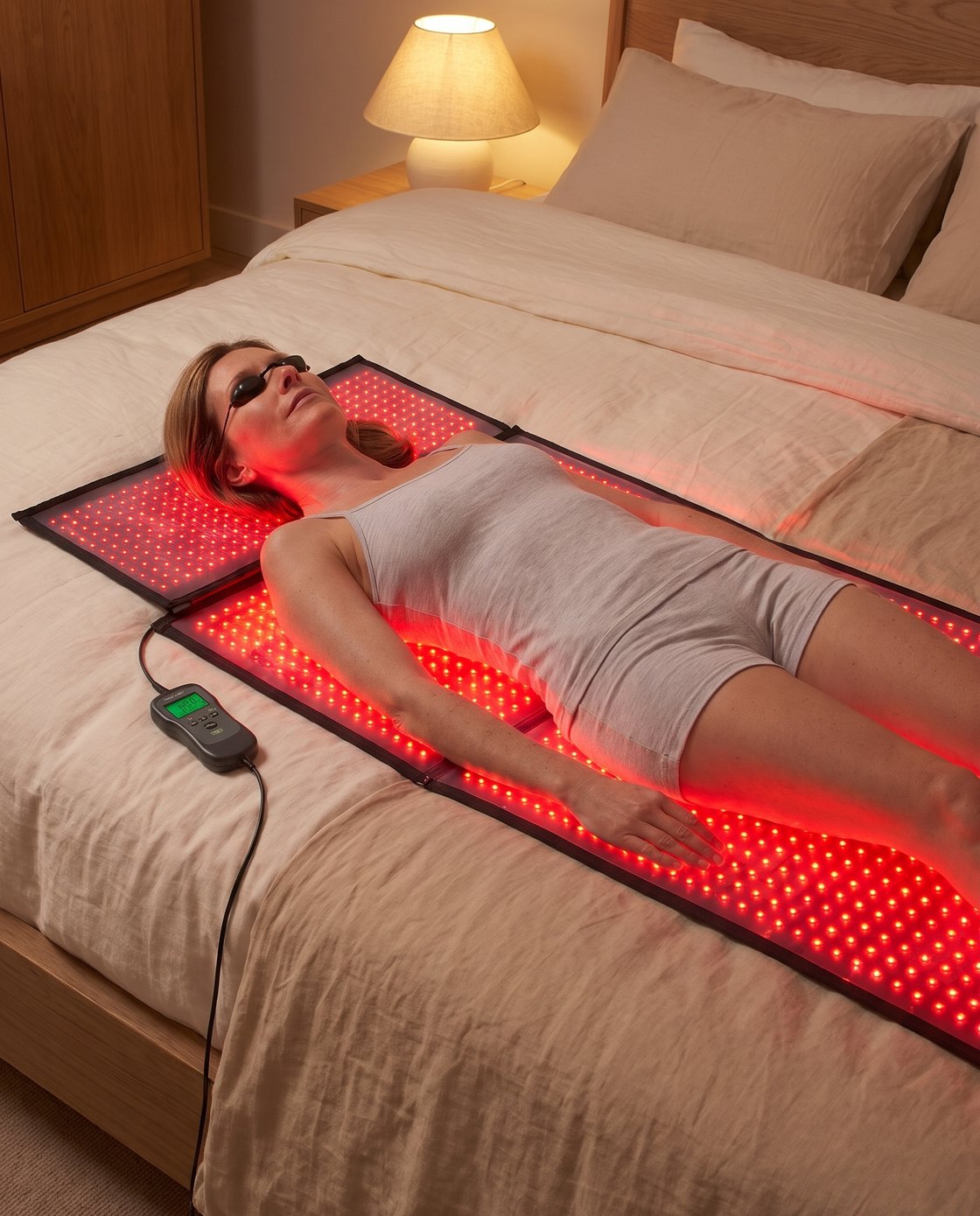
Skin
136 people used full-body red light units twice a week for 30 sessions. Their skin got smoother, and ultrasound measured denser collagen than in the control group.
Wunsch & Matuschka · Photomed Laser Surg · 2014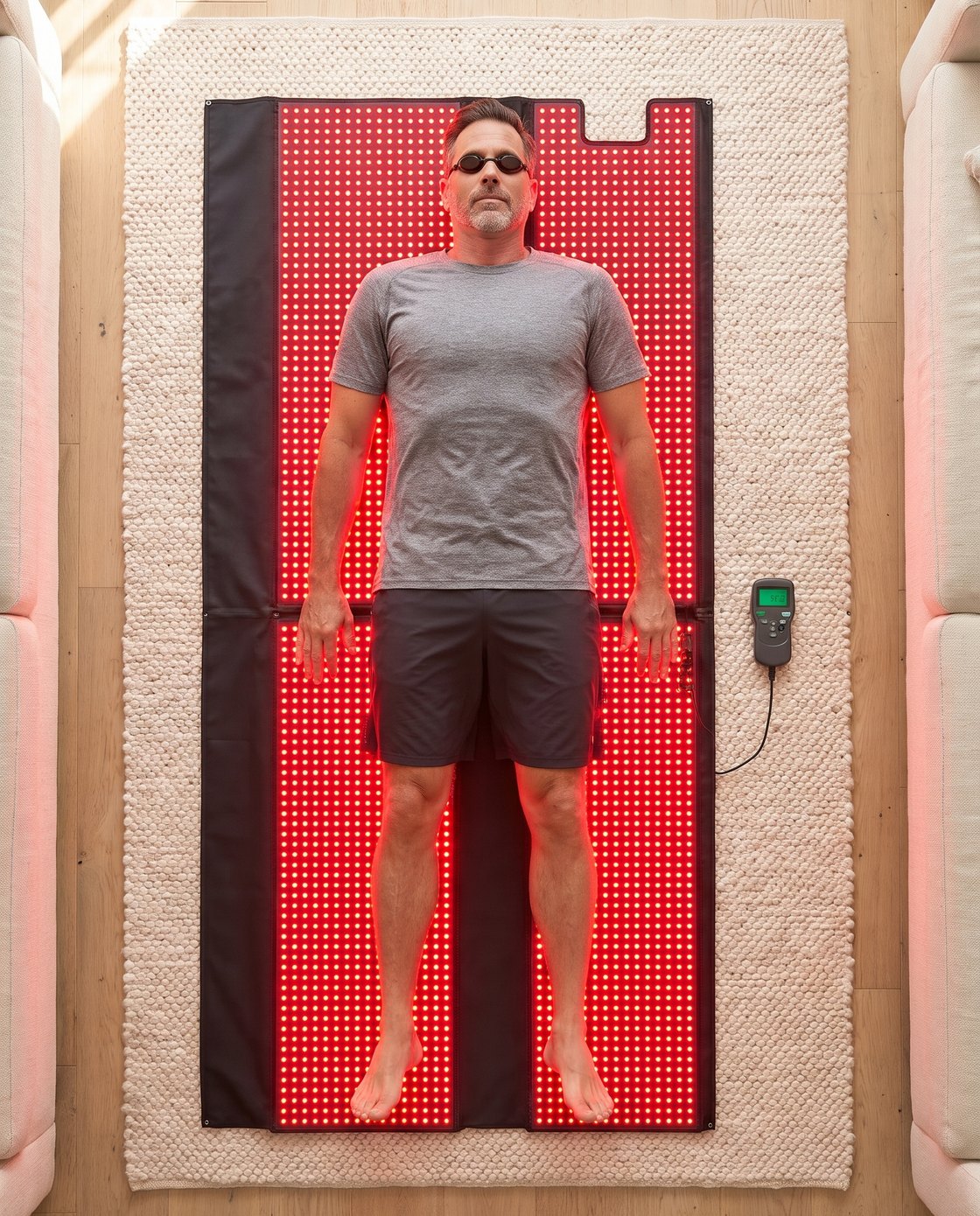
Recovery
Creatine kinase is your muscles’ check-engine light: it leaks into your blood when fibers tear. Pooled controlled trials found light before exercise improved performance and lowered it.
Leal-Junior et al. · Lasers Med Sci · 2015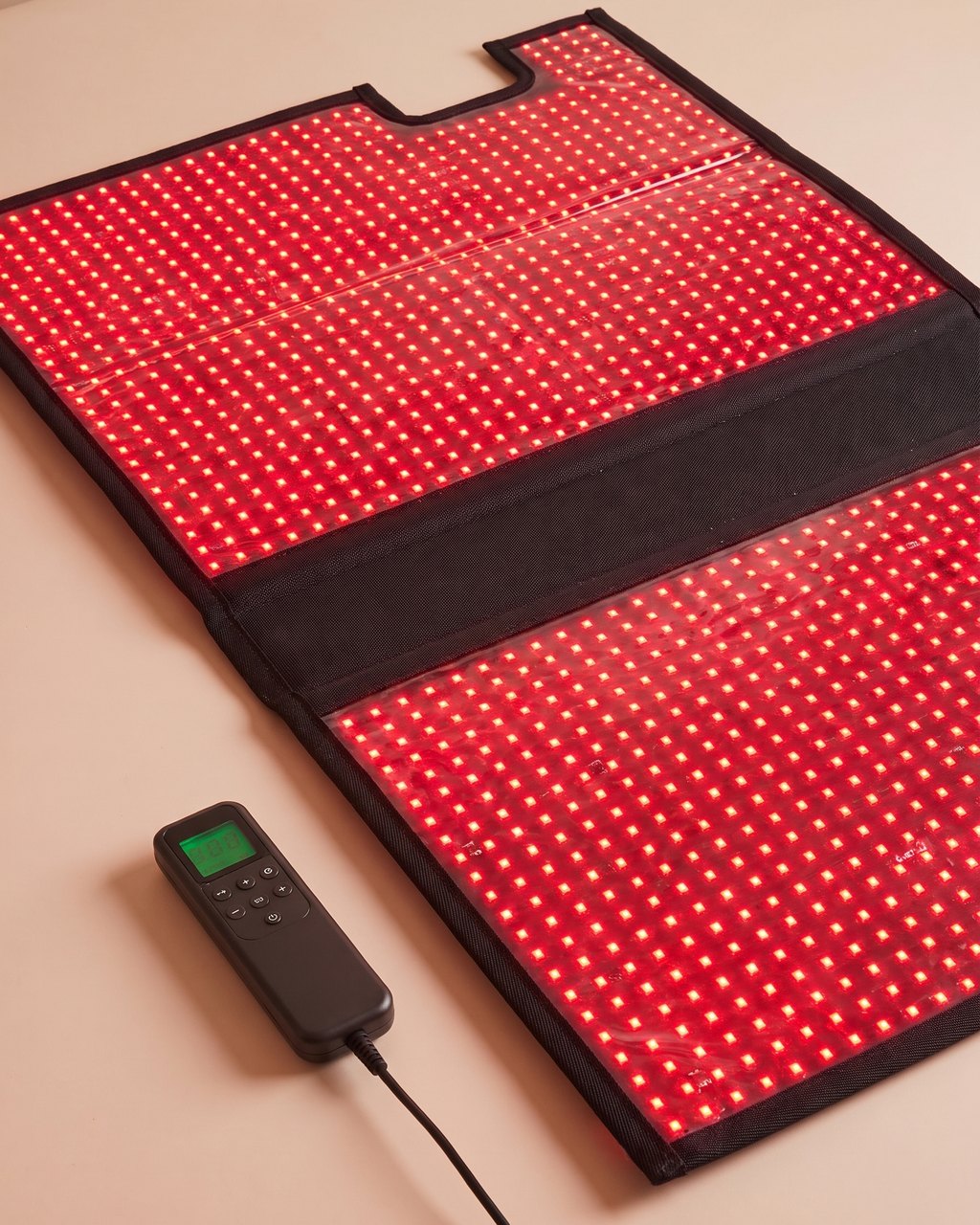
Neck
A meta-analysis of 16 randomized trials found low-level laser light reduced neck pain right after treatment in acute cases, and for up to 22 weeks after treatment in chronic cases.
Chow et al. · The Lancet · 200906 · The myths
Red light is just a fancy heat lamp.
Heat is something you feel. The effect studied in red light therapy depends on color, not warmth: specific wavelengths get absorbed by one specific enzyme in your mitochondria. A space heater warms the room. It doesn’t change how your cells make energy.
Karu · IUBMB Life · 2010Red light is basically a tanning bed.
Tanning and sunburn come from ultraviolet light, wavelengths shorter than 400 nanometers. Red at 660 nm and near-infrared at 850 nm are more than twice as long and carry no UV. Different part of the spectrum, completely different job.
World Health Organization · Ultraviolet radiationIt’s new-age wellness stuff.
The research started in a Budapest lab in 1967, which makes it older than the personal computer. Since then: thousands of published papers, including a meta-analysis of 16 randomized trials in The Lancet.
Mester et al. · 1968 · Chow et al. · The Lancet · 2009A wall panel does the same job.
Light obeys the inverse-square law: twice the distance, a quarter of the light. A panel also only reaches the side of you facing it. Lying inside the light, front and back, removes both problems.
Inverse-square lawYou’ll see it after one session.
Skin rebuilds on a schedule of weeks, not hours. The trials measured their results after 4 to 15 weeks of regular sessions. Consistency is the whole game.
Lee et al. 2007 · Wunsch & Matuschka 2014Sources
Journal, year and what they actually measured. Look any of them up.
A low-power ruby laser was aimed at shaved mice to test whether laser light caused cancer. It didn’t, and the hair on the lit mice grew back faster than on the others.
Mester, Szende & Gärtner · Radiobiologia Radiotherapia · 1968LED arrays first developed for NASA plant-growth experiments were tested on cultured cells, on wounds in lab animals and on people.
Whelan et al. · J Clinical Laser Medicine & Surgery · 2001Cytochrome c oxidase, part of the energy chain inside your mitochondria, absorbs red and near-infrared light and changes how the cell makes energy.
Karu · IUBMB Life · 2010Describes how red and near-infrared light can free nitric oxide from cytochrome c oxidase. Nitric oxide relaxes blood vessels.
Hamblin · Photochemistry and Photobiology · 2018Reviewed the dose response of low-level light: too little does nothing, the right dose helps, and too much can cancel the benefit.
Huang et al. · Dose-Response · 2009Full-body red light units, twice a week for 30 sessions. Skin complexion and roughness improved, and ultrasound measured higher collagen density than in the control group.
Wunsch & Matuschka · Photomedicine and Laser Surgery · 2014Adults with facial wrinkles used red (633 nm), near-infrared (830 nm), both, or a sham light for 4 weeks. The real-light groups showed less wrinkling and better elasticity than sham.
Lee et al. · Journal of Photochemistry and Photobiology B · 2007Pooled controlled trials: light applied before exercise improved performance and lowered creatine kinase, a blood marker of muscle damage.
Leal-Junior et al. · Lasers in Medical Science · 2015A meta-analysis of 16 randomized trials found low-level laser therapy reduced neck pain right after treatment in acute cases, and for up to 22 weeks after treatment in chronic cases.
Chow et al. · The Lancet · 2009The devices

Mars fact
Fine Martian dust spreads red light across the whole sky and lets blue through around the setting sun. We kept the red.
Shop all devices


